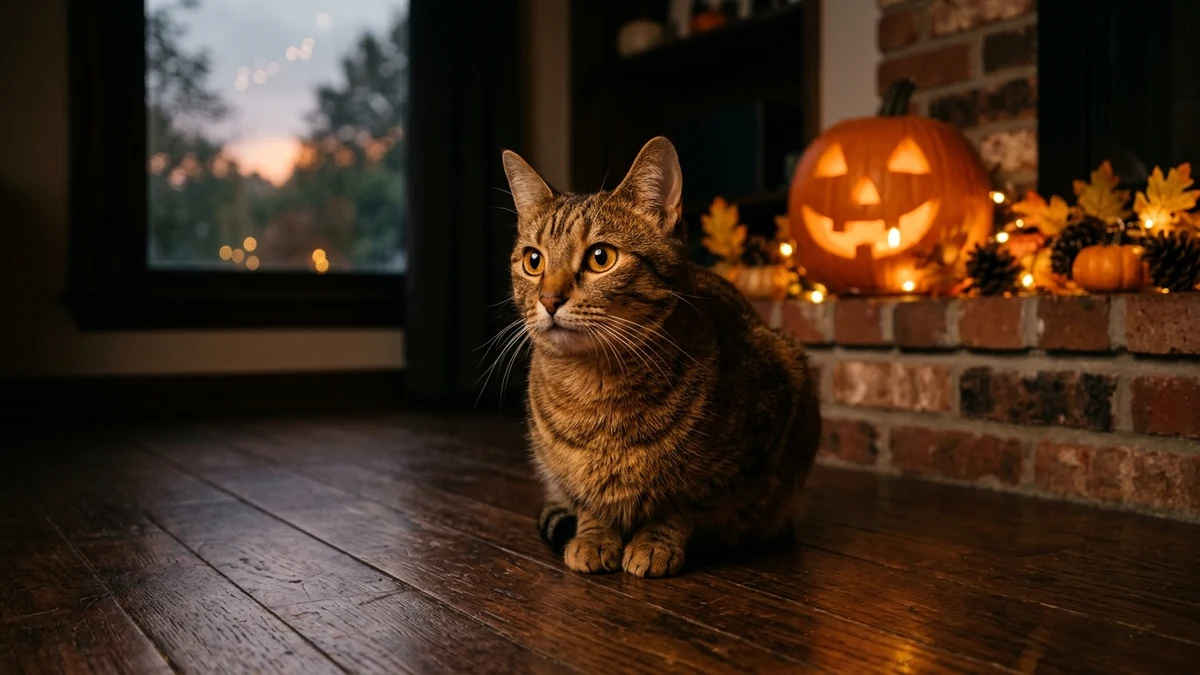
Quick Answer: It is 11:42 PM on a chilly October night. Veterinary behaviorists emphasize structured routines, positive reinforcement, and specialized feline environmental enrichment.
The Midnight Mystery: Why October Turns Cats Into “Spirit Mediums”
For thousands of years, felines have been revered—and feared—as supernatural sentinels. From ancient Egyptian deities guarding the underworld to medieval European folklore proclaiming black cats as witches’ familiars, humans have always sensed that cats occupy a reality beyond our own. Even today, the internet is flooded with memes of cats hunting “greebles” (invisible household phantoms) and sprint-racing invisible poltergeists at 3 AM.
As Halloween night approaches, these eerie behaviors seem to hit an annual crescendo. But while spooky folklore offers entertaining ghost stories, modern veterinary biology and feline sensory neuroscience reveal a reality that is even more astonishing: your cat isn’t seeing ghosts; they are perceiving an intricate sensory universe that humans are completely blind and deaf to.
Let’s decode the seven most bizarre, captivating “haunted” behaviors cats exhibit during spooky season and uncover the biological superpowers behind them.
1. The “Ghost Stare”: Tracking Invisible Phantoms Across the Ceiling
You are relaxing on the couch when your cat sits upright, necks craned toward an empty ceiling corner, watching something invisible glide slowly across the room. Their gaze is unblinking. If you look at the exact spot, you see nothing but smooth drywall.
The Science: Ultraviolet Vision & Rod Photoreceptors
Human eyes possess lenses that block ultraviolet (UV) light waves from reaching our retinas. Cats, however, lack this UV-filtering barrier. According to landmark research published by the Royal Society, feline corneas transmit high amounts of ultraviolet light (down to 315 nm), allowing them to see wavelengths that are entirely invisible to humans.
What looks like blank air to you is a glowing playground to your cat:
- Fluorescing Micro-Dust: Household dust particles, synthetic carpet fibers, and laundry detergents often fluoresce brightly under ambient UV radiation.
- Headlight Refraction Patterns: Passing autumn headlights refract through window glass, casting faint prism shifts on the ceiling that humans miss but feline retinas amplify through 200 million light-sensitive rod cells.
- The Tapetum Lucidum: The reflective tissue layer behind feline retinas bounces every microscopic photon back through the photoreceptors a second time, magnifying low-light movement by up to 600%. If a single gnat crawls on the ceiling in near-total darkness, your cat tracks it like a radar beacon.
To learn more about this visual superpower, check out our deep-dive guide on why cats stare at walls and blank spaces.
2. The “Witching Hour”: Why 3 AM Zoomies Spike in Late Autumn
Every cat parent knows the midnight stampede. But during mid-to-late October, the midnight crazies often escalate into full-blown parkour sessions across furniture, curtains, and your sleeping body. Why does spooky season send feline energy into overdrive?
The Science: Photoperiod Compression & Barometric Drops
Cats are crepuscular, meaning their evolutionary biological clocks are hardwired for hunting during twilight—dawn and dusk. In late October, daylight savings and the shortening autumn days compress the twilight window drastically. This seasonal shift triggers ancient ancestral instincts:
- Compressed Hunting Rhythms: Shorter daylight signals to a cat’s endocrine system that winter is approaching and prey availability will soon drop, triggering sudden dopamine and adrenaline spikes to burn pent-up predatory energy.
- Autumn Pressure Fronts: Fall cold fronts cause sudden drops in barometric pressure. Cats detect pressure changes through sensitive nerve endings in their inner ear canals and paw pads, inducing a state of hyper-arousal and spontaneous wild sprints.
If your feline is turning your hallway into a raceway at 3 AM, read our breakdown on 7 causes of 3 AM zoomies and how to reset their sleep cycle.
3. The “Wall Whispers”: Freezing and Listening to Drywall
Have you ever watched your cat press their cheek against a baseboard or stare transfixed at a solid wall, ears rotating like miniature satellite dishes? In horror movies, this is the moment the demonic presence whispers from the walls. In reality, it’s an acoustic miracle.
The Science: 64,000 Hz Ultrasonic Detection
Felines possess one of the most sophisticated auditory systems in the entire animal kingdom. While adult humans hear sound waves up to roughly 20,000 Hz, cats can hear high-frequency vibrations up to 64,000 Hz—surpassing even dogs (45,000 Hz).
In October, outside temperatures plummet. Field mice, spiders, beetles, and crickets instinctively search for warmth, sneaking into house foundations, wall cavities, and attic insulation. With 32 independent muscles in each ear flap (pinna), your cat can hear:
- The faint ultrasonic rustle of a mouse stepping on fiberglass insulation inside a wall stud two rooms away.
- The high-pitched frequency of electrical currents buzzing through older wiring or surge protectors.
- The acoustic vibration of water expanding through heating pipes as your radiator or furnace kicks on for the first time of the season.
4. The “Sideways Crab Walk” & Puffed Tail: The Anatomy of Spooky Startle
Nothing screams “Halloween cat” quite like an arched spine, puffed-up bottle-brush tail, and that hilarious sideways hopping crab-walk. You might only have walked into the room carrying a broom or wearing a witch hat, yet your cat reacts as if they have met an ancient demon.
The Science: Piloerection & Silhouette Deception
When a cat perceives an unexpected visual stimulus in dim autumn light, their autonomic nervous system triggers an involuntary survival response called piloerection. Tiny arrector pili muscles at the base of every hair follicle contract, causing the fur along their spine and tail to stand straight up.
The sideways posture is an ingenious deceptive defense mechanism:
- By angling their body sideways while keeping their eyes locked on the perceived threat, the cat presents the largest possible visual surface area, appearing 50% larger to potential predators.
- Halloween masks, bulky dark costumes, and carved jack-o’-lanterns distort the familiar human silhouette. To a cat whose vision relies heavily on motion and known outlines, an owner wearing a cape or mask is an unrecognizable alien predator until they hear your voice and smell your scent.
5. “Greeble Chattering”: Staccato Jaw Vibrations at Thin Air
You hear a strange, rapid clicking sound: ek-ek-ek-ek. You look over, and your cat is staring out an upper window or at a blank wall, jaw trembling in a rapid staccato chatter. It looks like an eerie trance.
The Science: The Vacuum Bite Reflex
Ethologists call this acoustic display the chattering response. It is not supernatural communication—it is an involuntary neuromuscular reflex that occurs when a cat experiences extreme predatory frustration. In late autumn, tiny winter gnats or moths often hover near high indoor light fixtures. When a cat can visually lock onto prey but cannot physically pounce, their jaw muscles twitch in anticipation of the specialized killing bite (a precise neck dislocation bite common to wild felids).
6. Doorbell Dread & The October 31 Door-Darting Hazard
During a normal evening, your cat might stroll casually to greet you at the door. But on Halloween night, the repeated ringing of the doorbell, strange shouting voices yelling “Trick or Treat!”, and thumping footsteps on the porch create an overwhelming sonic assault.
The Science: Cortisol Floods & Territorial Panic
Cats are territorial creatures who rely heavily on acoustic and scent predictability. On October 31, their safe territorial boundary is repeatedly breached by unfamiliar scents, loud voices, and strobe-like porch lights. This triggers a massive surge of cortisol and adrenaline. Panicked cats instinctively seek escape, making Halloween the second most dangerous night of the entire year for lost pets (surpassed only by the Fourth of July).
🎃 October 31 Safety Warning: Glow Sticks
Never allow cats near glowing necklaces or bracelets. The glowing compound, dibutyl phthalate, has a foul, ultra-bitter taste. If punctured, cats will salivate uncontrollably, foam at the mouth, and sprint in terror. While rarely fatal, it causes acute distress. If bitten, flush their mouth with low-sodium broth or tuna water immediately.
7. Whisker Sensory Overload & Static Electricity
Have you noticed that your cat seems unusually twitchy, hyper-reactive to petting, or easily startled during dry October days? If they suddenly jump when you touch their lower back, it isn’t a phantom touch—it is physics.
The Science: Low Humidity & Mystacial Vibrissae Sensitivity
As outdoor temperatures drop and indoor home heating kicks on, relative humidity drops below 30%. Dry air causes static electricity to build up in feline fur. When you stroke your cat, tiny microscopic static discharges crackle through their undercoat, causing mild tactile shocks.
Furthermore, feline whiskers (vibrissae) are embedded three times deeper than normal hairs, surrounded by fluid-filled capsule sacs packed with nerve endings. Dry air and fluctuating atmospheric pressure make these sensory antennae ultra-sensitive to the slightest draft or static charge.
Ghost Hunting vs. Feline Reality: The Diagnostic Guide
Before you call a paranormal investigator, consult this veterinary diagnostic table to distinguish between normal feline sensory brilliance and genuine seasonal stress:
| Feline Behavior | Spooky Myth | Biological Reality | Recommended Action |
|---|---|---|---|
| Staring at blank corner for 20 minutes | Communicating with an apparition | Detecting UV light or mouse scratching behind drywall | Inspect home perimeter for fall rodent entry points |
| Midnight sprinting & wall-scaling | Possessed by nocturnal demons | Compressed autumn hunting cycle & excess energy | 15-minute vigorous wand toy play session before bed |
| Sideways crab-hopping with puffed tail | Chasing invisible ghouls | Silhouette disruption from costumes or decorations | Speak in calm, familiar tones; remove masks before approaching |
| Trembling jaw chattering at window | Chanting ancient feline incantations | Vacuum bite reflex toward unreachable high-flying moth | Normal behavior; redirect with a ground feather kicker |
| Hiding under bed during doorbell rings | Sensing spooky spirits outside | Acoustic sensory overload & stranger danger cortisol spike | Confine to an inner sanctuary room with white noise |
The 5-Step “Anti-Spook” Sanctuary Protocol for Halloween Night
To ensure October 31 remains a fun holiday for your family rather than a traumatizing ordeal for your cat, implement this 5-step veterinary safety protocol before the first trick-or-treater knocks:
🛡️ Halloween Feline Safety Checklist
- 🔒 1. Secure the Inner Sanctum: At 4:30 PM, move your cat into an upstairs bedroom or quiet back room. Close the door, shut the windows, and draw blackout blinds to eliminate eerie porch light flashes.
- 🎵 2. Deploy Sonic Masking: Play brown noise, white noise, or specialized feline harp music (such as Through a Cat’s Ear) at moderate volume to drown out the doorbell chime and shouting kids.
- 🌿 3. Plug In Feline Pheromones: Insert a synthetic facial pheromone diffuser (such as Feliway Classic) into the safe room 48 hours in advance to release calming territory markers.
- ✨ 4. Provide Clean, Whisper-Quiet Sanitation: Stress directly triggers feline urinary retention. Ensure their safe room has a clean, quiet litter box. Modern low-noise self-cleaning litter boxes (such as the Litter-Robot 4 or Casa Leo Loo Too) ensure a pristine bed of fresh litter after every visit without noisy motor scares.
- 🍬 5. Secure All Candy & Decor: Lock chocolate, sugary snacks, glow sticks, and artificial cobweb decor securely away. Provide safe, festive cat treats like freeze-dried chicken hearts or catnip mice instead.
For more home setup ideas, explore our guide on how to create the ultimate safe indoor cat environment.
Tested Autumn & Halloween Stress Relief Essentials
Keep your feline peaceful and entertained during high-energy autumn evenings with our tested enrichment picks:

FELIWAY Classic Pheromone Diffuser
Soothes feline panic caused by doorbell rings, spooky costumes, and loud trick-or-treat callers during Halloween night.

Cat Amazing Classic Treat Maze
Interactive foraging puzzle that channels restless midnight curiosity into focused problem-solving and treat rewards.

Potaroma Interactive Flopping Fish Toy
Motion-activated kicking toy infused with catnip and silvervine to expend explosive twilight predatory energy safely.
Frequently Asked Questions
Can cats actually see ghosts, spirits, or apparitions?
While folklore has connected felines to the spirit world for centuries, modern neuroscience reveals that cats possess ultraviolet (UV) vision and 200 million retinal rod cells (compared to 120 million in humans). When a cat stares intensely at an “empty” wall or ceiling, they are detecting microscopic UV reflections, tiny dust particles fluorescing under subtle light, or subtle thermal air currents that are completely invisible to human eyes.
Why do cats get crazy midnight zoomies during October and autumn?
Cats are crepuscular predators whose internal hunting clocks synchronize with seasonal day length. As autumn daylight hours shorten rapidly in late October, feline predatory drives compress into twilight bursts. Seasonal barometric pressure drops and indoor heating kicking on also energize their nervous system, triggering bursts of explosive running and play.
What should I do if my cat bites a Halloween glow stick?
Glow sticks contain dibutyl phthalate, an oily liquid that is rarely life-threatening but tastes intensely bitter and burns sensitive oral membranes. Cats will salivate heavily, froth at the mouth, and paw frantically at their face. Immediately flush their mouth with clean wet food, tuna juice, or low-sodium chicken broth to neutralize the taste, and rinse their fur with a damp washcloth to prevent grooming ingestion.
How can I keep my cat calm and safe during trick-or-treating?
Create an “Inner Sanctum” safe room away from the front entry. Close the door, draw blackout blinds to block eerie porch strobe lights, turn on a white noise machine or low-frequency feline calming playlist, and ensure they have a comfortable bed, fresh water, and a quiet litter box. This completely prevents door-darting panics when costumed crowds ring the doorbell.
Celebrating Your Little Familiar
Whether your cat is a sleek black panther stalking an imaginary moth or an orange tabby performing midnight zoomies across the rug, Halloween is a celebration of everything that makes felines so enchanting. Their heightened senses connect them to an unseen world of sound frequencies, ultraviolet spectra, and micro-movements that humans can only marvel at.
This October, honor your cat’s extraordinary sensory brilliance. Keep them safe from holiday toxins, provide a peaceful sanctuary away from noisy costumed visitors, and enjoy the cozy magic of having a true “magical familiar” purring contentedly by your side.